When I first learned about Pain Reprocessing Therapy, I had already spent years trying to get better.
I had seen specialist after specialist. I had accumulated diagnoses, medications, treatments, exercises, restrictions, and an increasingly long list of things my body apparently could not handle. At my worst, I was largely bedridden and using a wheelchair. So I wasn’t exactly looking for another interesting theory about pain. I wanted someone to figure out what was wrong with my body and fix it.
Pain Reprocessing Therapy asked me to consider a very different possibility: What if at least some of the symptoms I was working so hard to fix were being produced by a nervous system that had learned to believe I needed protection?
That is the basic premise behind PRT. Pain Reprocessing Therapy is an approach designed to help people change the way the brain interprets and responds to sensations that have become associated with danger. Rather than assuming that chronic pain always means ongoing damage in the body, PRT looks at whether the brain’s protective system may have become sensitized or learned to produce pain in situations that are actually safe.
If that idea is completely new to you, I go much deeper into the science and concept in What Is Neuroplastic Pain? For now, the important part is this: pain can be completely real without being an accurate measurement of damage. And if the brain can learn that a sensation, movement, activity, or situation is dangerous, there is also the possibility that it can learn something different.
PRT is about creating that new learning.
PRT is not about convincing yourself that you’re safe
I think this is where PRT can sound much simpler from the outside than it actually is. You learn that your pain might be neuroplastic. Someone tells you that your body is safe. You tell yourself, This is safe. I’m okay. There’s nothing wrong with me. Pain disappears. The end. Lovely.
Unfortunately, nervous systems do not generally operate like customer service representatives who simply needed you to submit the correct information. You can intellectually understand neuroplastic pain and still have your entire body react as though something is terribly wrong the moment a familiar symptom appears. I’ve worked with people who can explain PRT back to me beautifully and then feel a sensation five minutes later and immediately think, Nope. This one is definitely damage. I understand that disconnect because I experienced it myself. Knowing something and feeling safe enough for your brain to believe it are not always the same thing.
That is why PRT isn’t primarily about repeating reassuring statements or thinking positively. We’re trying to create experiences that give the brain a reason to update its predictions. Maybe you bend over without bracing and discover that nothing terrible happens. Maybe you notice a sensation for thirty seconds without immediately analyzing, fighting, or trying to fix it. Maybe you realize you walked through Target for twenty minutes before remembering that your foot was supposed to hurt. Maybe a symptom appears and, for the first time, you don’t treat its arrival like breaking news. Those moments can seem small. From a learning perspective, they aren’t.
For years, my own brain had been collecting evidence that my body was fragile. Pain meant stop. Fatigue meant I had done too much. A new sensation meant something else might be wrong. Every unsuccessful treatment seemed to add another piece of evidence to the case. PRT gave me a way to start collecting evidence in the other direction.
There isn’t one magical PRT exercise
This is probably one of the biggest misconceptions I would want to correct about PRT. Somatic tracking is closely associated with it, so sometimes people encounter PRT online and come away thinking the treatment is essentially: pay attention to your pain while telling yourself it’s safe. Somatic tracking can be incredibly useful. It is also one tool.
There isn’t one magical PRT exercise.
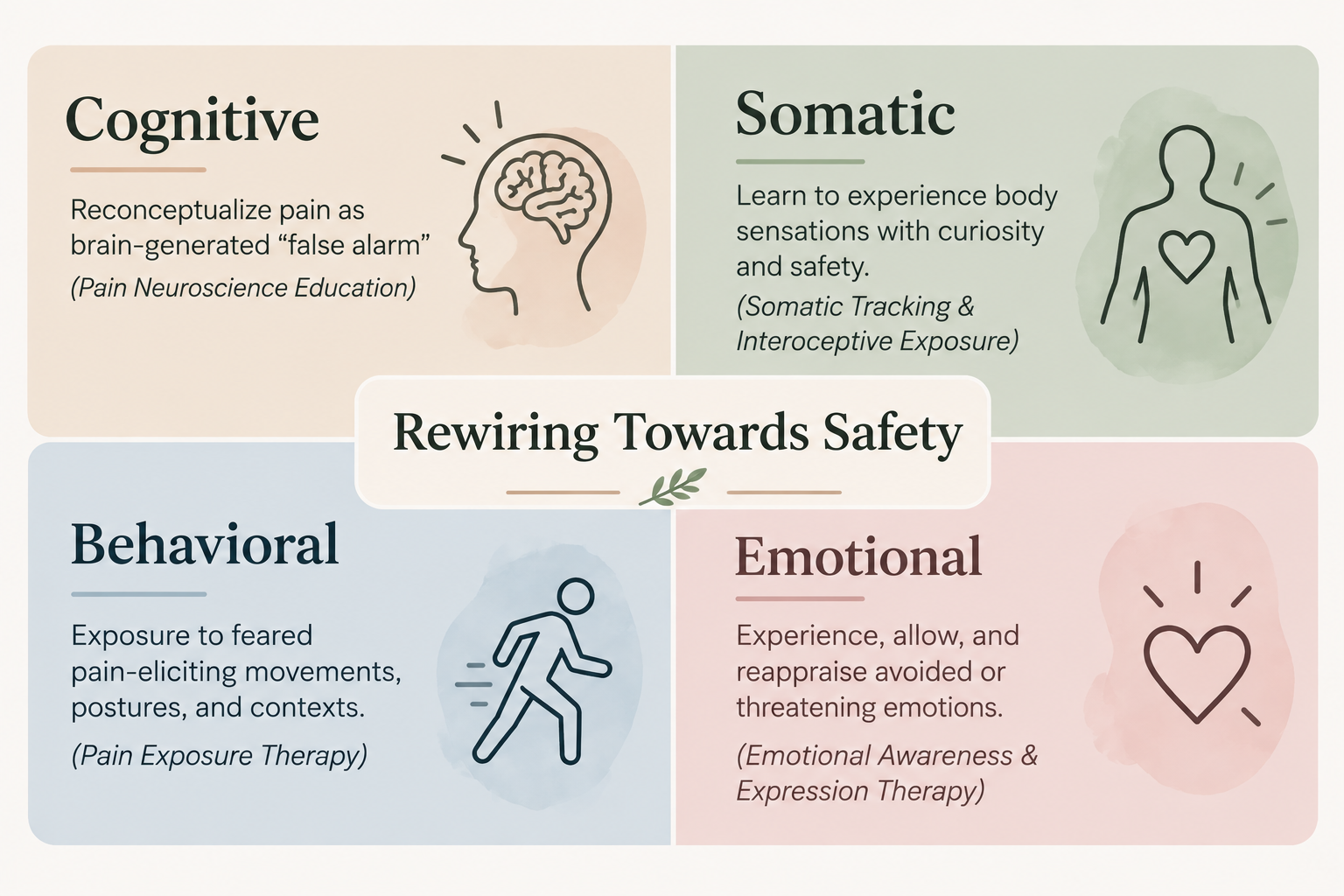
PRT can involve several different areas of work, depending on what is keeping your nervous system in a pattern of danger and protection.
With one person, we might spend time noticing a sensation with curiosity because they are terrified every time it appears. With someone else, paying even more attention to the symptom is the last thing they need because they have already been monitoring it all day. We may work with a movement they have learned to fear, look at what happens internally when symptoms flare, practice shifting attention, build positive experiences, or examine the constant pressure they put on themselves.
Sometimes emotional work is relevant too. If someone’s nervous system has learned that anger, conflict, grief, or another emotional experience is threatening, approaches such as Emotional Awareness and Expression Therapy (EAET) can complement PRT. But I don’t assume that every person with chronic symptoms has buried trauma that needs to be uncovered. Sometimes we need to work on anger. Sometimes we need to work on walking around Target without checking your foot every thirty seconds.
Both can be nervous-system work.
The common thread isn’t the exercise. It’s the learning.
What has your brain learned is dangerous, and what experiences might help it learn something new?
That’s the question underneath a lot of what I do.
PRT also changes the way we respond to symptoms
Before I understood this work, symptoms were information I took very seriously. If something hurt, I needed to figure out why. If a symptom increased, I wanted to know what I had done. If something new appeared, I analyzed it. I was constantly gathering information about my body because, from my perspective, that was the responsible thing to do. I was sick. Of course I should pay attention. The problem was that my body had become the subject of an investigation that never ended.
This is something I recognize quickly now when I’m working with someone. Sometimes the fear isn’t dramatic. A person isn’t consciously thinking, I am terrified of this sensation. They’re checking. Comparing today with yesterday. Testing a movement. Googling. Trying to determine whether the treatment is working. Wondering whether the symptom moved. Planning around what their body might do later.
None of those behaviors means someone caused their symptoms. They’re completely understandable responses to living in a body that feels unpredictable. But when the brain already believes a sensation is dangerous, treating it like something that requires constant surveillance can reinforce its importance.
PRT gives us room to experiment with another response. Not ignoring the body. Not forcing ourselves through symptoms. Not pretending we don’t care. Just gradually changing the relationship from Oh no, what does this mean? toward Okay. I know what this may be. Let’s see what happens. That shift was enormous for me.
The part I find most interesting is the individual pattern
Two people can show up to session with back pain and have very different things keeping their nervous systems on alert. One may be afraid to bend because they were told their spine was damaged. Another may have no fear of movement but check their symptoms constantly. Someone else notices that pain reliably flares around conflict but has never connected the two. Another person has a symptom history so inconsistent that they have spent years wondering why their body refuses to follow any rules. I’m much more interested in those details than I am in handing everyone the same PRT worksheet.
What happened when this started? What has your body learned since then? What have you stopped doing? What do you believe a symptom means when it appears? Where does your body break its own rules? What has surprised you? That is where PRT becomes much more than understanding a theory about the brain.
For me, the theory mattered. But what ultimately changed things wasn’t becoming exceptionally knowledgeable about pain neuroscience. It was beginning to experience my body differently. For years, I had been asking some version of What is wrong with me? Every symptom seemed like another piece of evidence that my body was damaged, unreliable, or fragile. PRT introduced a question I hadn’t spent much time considering:
What if my body isn’t as broken as it feels?
I didn’t believe that perfectly. I didn’t wake up one morning completely fearless. My brain had become extremely good at protecting me. The possibility I hadn’t considered was that it could learn to protect me less.
That’s still what I find hopeful about this work now. Not that every symptom is neuroplastic. Not that everyone needs the same treatment. And definitely not that you should be able to read an explanation like this and immediately convince your nervous system that everything is fine.
It’s that sometimes symptoms that have made your body feel permanently damaged are being produced or amplified by a system that is capable of change.
I offer free 15-minute connect calls where we can talk about what your symptoms actually do, what you’ve already been through, and whether Pain Reprocessing Therapy might make sense for your situation.
If you’re still figuring out how all of this might relate to your own symptoms, you may also find these articles helpful:
What Is Neuroplastic Pain? explains how the brain and nervous system can learn to produce real physical symptoms, even when the body is not in danger.
How Do I Know If My Symptoms Are Neuroplastic? walks through some of the patterns and clues that may suggest a neuroplastic component to persistent symptoms.
Research: Ashar YK, et al. JAMA Psychiatry (2022). View the study
About the Author
Amberleigh Maida, ICF-ACC, is an Advanced Pain Reprocessing Therapy (PRT) Practitioner with additional training in Emotional Awareness and Expression Therapy (EAET). Having experienced and recovered from years of debilitating chronic pain herself, she brings both professional training and lived experience to her work. She also holds a master’s degree in creative writing with a focus on nonfiction. Through her writing, she explores neuroplastic symptoms, the brain-body connection, and evidence-based approaches to chronic pain and other persistent symptoms.
Learn more about Amberleigh’s personal story and approach or explore her professional credentials and training.
