But my MRI actually showed something.
This is usually where the neuroplastic pain conversation gets a little more complicated. Maybe your MRI showed arthritis. Or disc degeneration. Or a bulging disc. Maybe you have an old injury that you can point to and say, There. That’s when all of this started. And when someone starts talking about the brain and nervous system after you’ve spent months or years looking at an image that quite literally shows something different about your body, it makes sense to wonder whether any of this applies to you at all. If there’s something structural there, doesn’t that mean the pain must be structural too?
Sometimes, yes. But bodies are annoyingly unwilling to be that simple. A structural change can contribute to pain without necessarily explaining all of it, and a very real injury can be the thing that starts a pain experience without remaining the thing that keeps it going years later. We also know that many of the changes that sound alarming on an MRI—things like disc degeneration and bulging discs—are found in plenty of people who aren’t experiencing pain at all. That doesn’t make those findings meaningless. It just means an MRI gives us one piece of information about what a body looks like. It doesn’t always tell us why that particular body hurts as much as it does, why it hurts today but barely hurt yesterday, or why the pain sometimes changes when nothing about the structure possibly could have changed.
That distinction mattered to me in my own recovery because, for years, I was looking for the explanation that would finally make everything fit. A diagnosis. A test result. A treatment target. Something concrete enough to explain why my body felt the way it did. I understand the relief that can come with finally being shown something and thinking, There it is. There’s the reason. The problem is that sometimes the finding becomes the whole story before we’ve stopped to ask whether it actually explains the whole story.
PRT doesn’t require pretending your MRI is normal. It asks whether the structural finding explains the whole story.
An abnormal MRI doesn’t automatically explain the pain
One of the things I find most interesting about pain science is just how common “abnormal” imaging findings actually are. In one systematic review, researchers looked at spinal imaging from 3,110 people who had no pain. At age 20, 37% had disc degeneration and 30% had a disc bulge. By age 50, those numbers had risen to 80% and 60%. By age 80, 96% had disc degeneration and 84% had a disc bulge. The researchers concluded that many degenerative imaging findings are likely part of normal aging and need to be interpreted in the context of the individual person.
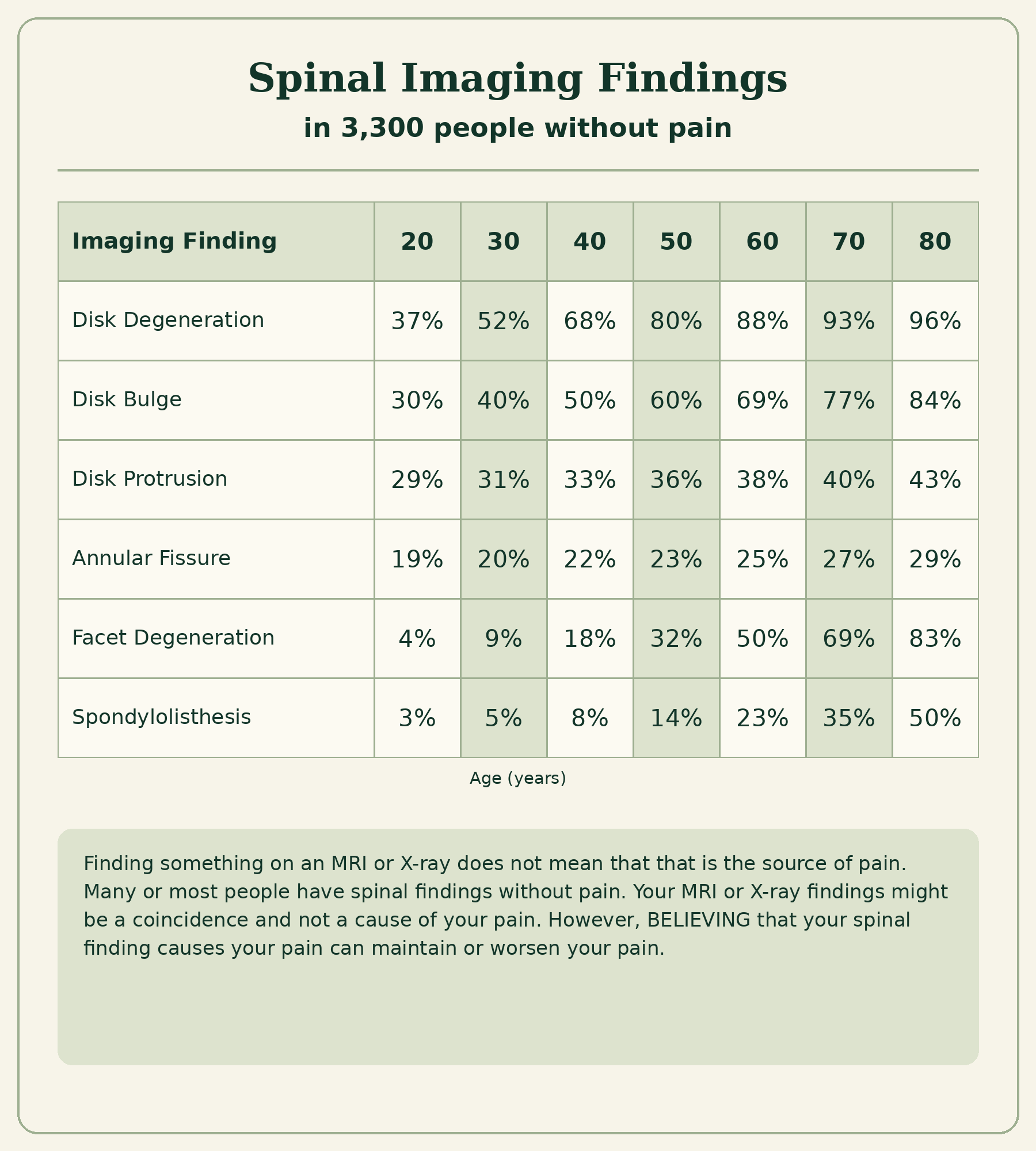
I think this matters because the language used in imaging reports can sound terrifying when you don’t spend your days reading imaging reports. Degeneration. Bulge. Protrusion. Fissure. None of those words exactly scream, Your body is doing awesome! And once you know something is there, it can become very difficult not to picture it every time you hurt. You bend over and your back twinges, and suddenly you’re not just experiencing a sensation. You’re imagining the disc. You turn your neck and feel pain, and your mind goes immediately to the arthritis someone showed you on an X-ray three years ago. The image can become part of what your brain expects from your body.
That doesn’t mean the arthritis or disc degeneration is irrelevant. Some structural findings absolutely do cause pain, and imaging can provide important information that changes medical treatment. I don’t interpret clients’ MRIs or tell someone that a structural finding is harmless; that’s a conversation to have with an appropriately qualified medical provider. But once someone has been appropriately evaluated, I do think there is another question worth asking: Does this finding adequately explain the way my symptoms are behaving? Sometimes it does. And sometimes there are pieces of the story it doesn’t explain very well at all.
Structural and neuroplastic aren’t opposites
I think this is where we can accidentally make neuroplastic pain much more black-and-white than it actually is. We start imagining two boxes: either your pain is structural and therefore “real,” or it’s neuroplastic and therefore nothing is physically wrong. But there can be a both. A structural problem can exist while the nervous system also becomes sensitized or increasingly protective, and the fact that an injury genuinely hurt at one point does not necessarily tell us what is producing every bit of pain years later.
Imagine that you injure your knee. The injury hurts because, well, you injured your knee. Your brain is doing exactly what you would want it to do: creating pain to protect an area that needs time to heal. But during those weeks or months, your brain is also learning. It learns that bending the knee hurts. Stairs hurt. Running hurts. Maybe you start bracing before you stand up or watching every step you take. Maybe every little sensation in that knee begins to feel significant because, for a while, it was significant. Then the tissue heals, but unfortunately the nervous system doesn’t necessarily receive a memo that says, Okay everyone, we’re good here. Stand down. Sometimes the protection sticks around.
That’s one reason I’m much more interested in the whole symptom story than I am in putting someone into a category. If you hurt your back five years ago, the fact that your symptoms began with an injury matters. Then I want to know what happened next. Did the pain remain exactly the same, or did it begin changing? Did it spread? Does it sometimes disappear almost completely and then return? Is it worse during stressful periods or unexpectedly better when you’re away on vacation? Does one movement hurt terribly one day and barely bother you another? Have you stopped doing certain things because you’re afraid of what will happen afterward? If the structure appears relatively stable while the pain is wildly variable, I want to understand what else might be contributing.
None of those things, by themselves, prove that pain is neuroplastic. I really don’t like treating neuroplastic pain like a checklist where five checked boxes earn you a diagnosis. Bodies are too complicated for that, and sometimes there really is an ongoing physical problem that needs treatment. But patterns give us information. If your pain changes dramatically with context, attention, expectation, or fear, that is information. If you can sometimes do something without pain that normally hurts, that is information. If the pain has spread far beyond the original injury or developed rules that don’t seem to make much anatomical sense, that is information too. I’m not trying to talk someone out of believing their body. I’m trying to understand what the whole body is doing.
So instead of only asking, Is my pain structural or neuroplastic?, I think a more useful question is often: How much of the protection I’m experiencing now is still necessary?
Where PRT can fit when there really is something structural
Pain Reprocessing Therapy isn’t appropriate because we’ve somehow proven that every physical finding in your body is meaningless. The goal is to help reduce unnecessary fear and protection around sensations or activities that are actually safe. That might involve understanding how pain works, gathering evidence that your body may be safer than it feels, noticing sensations without immediately interpreting them as damage, or gradually returning to movements your brain has learned to fear. But what that looks like can be very different from one person to another.
For one client, the biggest piece might be that they cannot bend over without picturing the MRI they were shown three years ago. Someone else may have recovered physically from an injury but slowly built an entire life around avoiding anything that could provoke the pain again. Another person may have an ongoing structural issue, but the severity and unpredictability of the symptoms don’t seem to match what doctors have found. Someone else may tell me that the pain is always there—and then, as we talk, remember the afternoon they walked around somewhere they loved for two hours and barely noticed it. Those details interest me because they tell us something about what the nervous system has learned and where there may be room for it to learn something different.
And if there is an ongoing structural contributor, working with the nervous system doesn’t require denying it. I sometimes think of it as asking whether the situation needs one alarm or five. Maybe there is something happening in the body that deserves an alarm. But if the nervous system has become increasingly sensitized, fearful, and protective around it, it may be producing far more protection than the situation actually requires. We don’t have to pretend the first alarm is unnecessary in order to work on the other four.
You don’t have to choose between believing your body and believing your brain
This is probably the part I care about most. If you’ve spent years being told that tests are normal when you know very clearly that you are not fine, finally seeing something on a scan can feel incredibly validating. There it is. Proof. And then someone comes along and starts talking about neuroplasticity, and it can sound suspiciously like they’re trying to take that explanation away again. I’m not interested in doing that. Your imaging matters. Your medical history matters. How your symptoms began matters. And the way those symptoms behave now matters too.
If something needs medical treatment, PRT is not a replacement for that treatment. If you’re unsure whether your symptoms have been adequately evaluated, getting appropriate medical care matters more than trying to convince yourself that you’re safe. But once that evaluation has happened, we can leave room for another possibility too: your body can have structural changes without every bit of pain being a direct measurement of those changes. You can have arthritis and a sensitized nervous system, an old injury and learned fear around movement, or a disc bulge and pain that is being amplified by the brain’s expectation that bending is dangerous. You can even have a structural source of some pain and unnecessary protection layered on top of it. The existence of one does not erase the other.
This is why, when someone comes to me with an MRI finding, I’m not looking for a way to convince them it doesn’t matter. I want to know what they were told about it, what their symptoms actually do, what makes them better or worse, what they’ve stopped doing because of it, and whether the structural explanation they’ve been given makes sense of the whole picture. Sometimes it does. Sometimes we start finding pieces that don’t fit quite as neatly as they seemed to at first. And sometimes simply realizing that the MRI might not have to explain everything creates a little room for a person to relate to their body differently.
So maybe the question to leave with isn’t, Can I prove that absolutely nothing is wrong with my body? I don’t think that’s a particularly helpful standard anyway.
Maybe the question is, Does my body need as much protection as my brain has learned to give it?
That’s the question I want to explore with you. If you’re wondering whether your own symptoms may have a neuroplastic component, you can start with my Neuroplastic Symptoms Self-Assessment or read How Do I Know If My Symptoms Are Neuroplastic? And if you’d rather talk through your particular symptom history with someone, I offer a free 15-minute connect call to see whether Pain Reprocessing Therapy might be a good fit.
Research: Brinjikji W, et al. AJNR (2015). View the study
About the Author
Amberleigh Maida, ICF-ACC, is an Advanced Pain Reprocessing Therapy (PRT) Practitioner with additional training in Emotional Awareness and Expression Therapy (EAET). Having experienced and recovered from years of debilitating chronic pain herself, she brings both professional training and lived experience to her work. She also holds a master’s degree in creative writing with a focus on nonfiction. Through her writing, she explores neuroplastic symptoms, the brain-body connection, and evidence-based approaches to chronic pain and other persistent symptoms.
Learn more about Amberleigh’s personal story and approach or explore her professional credentials and training.
