Wait. Being afraid of my pain can actually make the pain worse?
It sounds a little unfair, doesn’t it? You’re already in pain. Of course you’re afraid of it. And now someone is telling you that being afraid of it might actually be contributing to the problem? When I first learned about the pain-fear cycle, I honestly thought this part was infuriating. At the time, I was bedridden and in pain throughout my entire body, and I could not comprehend the idea that I was somehow supposed to stop being afraid of it. Of course I’m afraid of it. Look at what it has done to my life. Pain had taken away my independence, my ability to work, and so many of the normal things I wanted to be doing. The idea that I should experience all of that and respond with less fear felt almost insulting.
That experience is part of why I’m careful about how I explain the pain-fear cycle now. It isn’t the idea that fear magically creates pain, or that you would be fine if you could just stop worrying about it. It describes something much more understandable: pain can make us afraid, fear changes the way we pay attention to and respond to pain, and those protective responses can sometimes reinforce the brain’s belief that the pain is dangerous. When that happens, pain creates more fear, fear creates more protection, and the cycle can keep feeding itself.
Fear is a completely reasonable response to pain. Pain is supposed to get our attention. If you put your hand on a hot stove, you do not want your brain calmly observing the burning sensation with detached curiosity. You want it screaming, MOVE YOUR HAND. Pain exists, at least in part, to protect us, so when something hurts, our instinct is to assume something is wrong and then do whatever we can to make sure we don’t make it worse. That system is incredibly useful when there is actually something our body needs protection from.
The problem with neuroplastic pain is that the same protective system can keep responding as though there is danger even when the body no longer needs that level of protection. The pain feels dangerous, so naturally we become afraid. But that fear also tells the brain something: This sensation is important. Pay attention. Something may be wrong. We become more vigilant, the sensation gets more attention, and the brain gets even more evidence that this is something worth protecting us from.
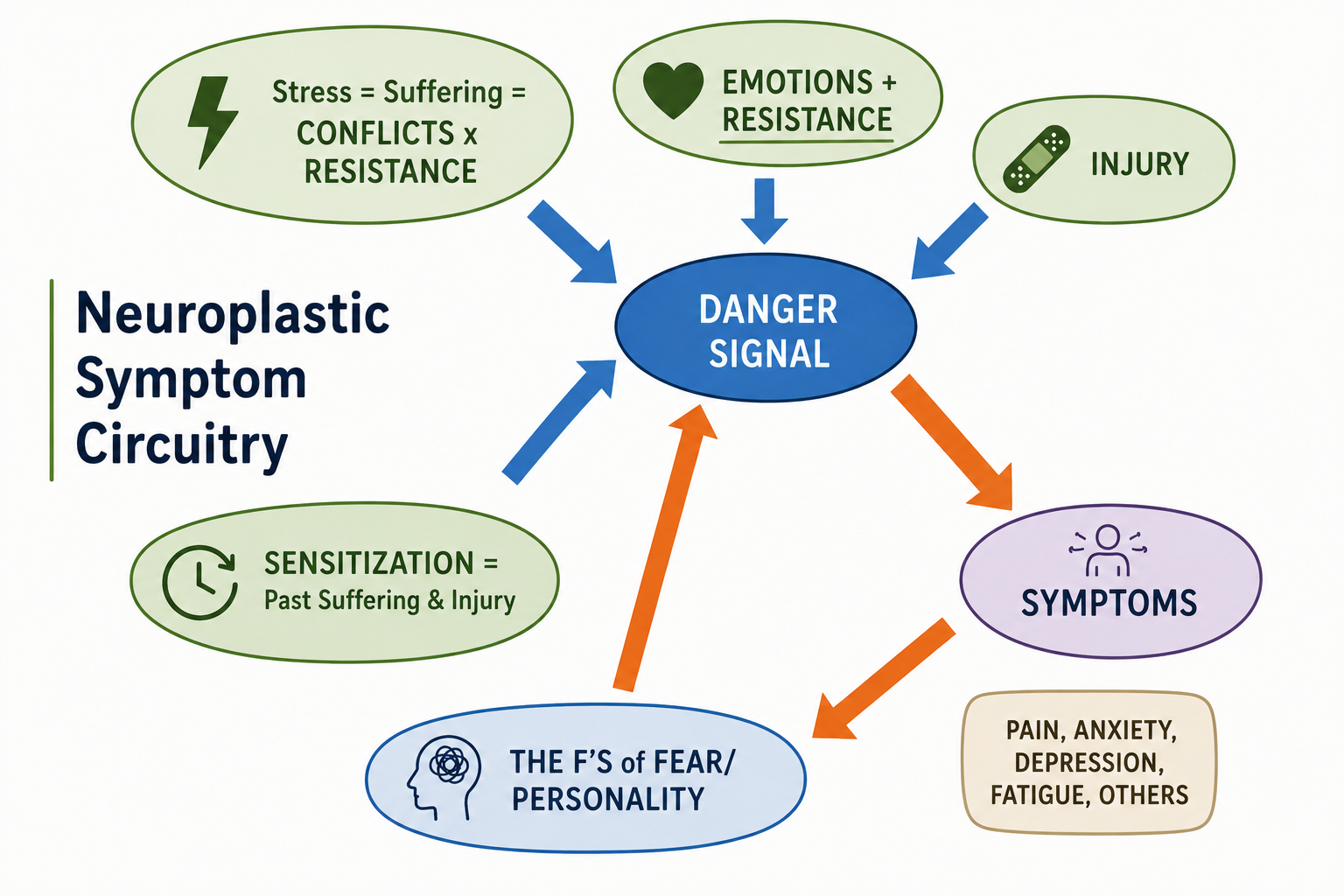
The pain-fear cycle: Symptoms can increase fear and protective responses, which can reinforce the brain’s perception of danger and contribute to more symptoms.
That’s the pain-fear cycle: Pain → Danger → Fear → Increased attention and protection → More pain → More fear.
Fear changes what we do with pain
Imagine you wake up tomorrow morning with a sharp pain in your back. You have no idea where it came from. You sit up and immediately think, What was that? You bend forward experimentally. Still there. You twist to the left. Worse. Now you’re reviewing yesterday. Did you lift something? Sleep weird? Was it that workout? By lunchtime, you have Googled three different combinations of sharp back pain when bending over and have been monitoring your back every time you move.
None of this is ridiculous. Your brain has received information that might indicate danger, and you’re trying to figure out what to do with it. But look at how quickly the sensation has become important. You’re watching it, checking it, testing it, analyzing it, and maybe beginning to avoid movements that seem to make it worse. Every time it appears, there’s a little Oh no. Your brain is paying attention too.
Pain isn’t a direct measurement of damage, which was one of the ideas that took me a long time to fully understand. The brain interprets information from the body alongside things like context, previous experiences, expectations, and perceived danger. When we believe a sensation is dangerous, we naturally pay closer attention to it and protect ourselves from whatever seems to provoke it. When there is an actual injury that needs protection, that’s useful. But when a movement or sensation is safe and the brain has learned otherwise, all of that checking, guarding, and avoiding can unintentionally reinforce the original conclusion: Yep. This is something we need to worry about.
Fear doesn’t always look like fear
This is the part I think gets especially interesting, because when I talk about fear of pain with clients, they don’t always identify with the word fear. They might tell me, “I’m not really afraid of it anymore. I’m just frustrated.” And that may be completely true. But then we start looking at what actually happens when the symptom appears.
Sometimes fear looks like checking: Is it still there? Sometimes it looks like testing: What if I bend this way? Okay, what about this way? It can look like Googling, researching, comparing today’s symptoms with yesterday’s, repeatedly asking for reassurance, or mentally reviewing everything you did before a flare. It can look like bracing your body before a movement, avoiding an activity “just in case,” or feeling your stomach drop the second you notice the first hint of a familiar sensation. And sometimes it looks like anger: Seriously? Again?
I had plenty of moments in my own experience when I would have insisted I wasn’t afraid of a sensation while simultaneously monitoring it like I had been personally assigned to its security detail. That’s why I’m less interested in whether someone says, “Yes, I am afraid of my pain,” and more interested in what happens next. Where does your attention go when the symptom appears? What do you immediately want to do? What are you afraid might happen if you didn’t respond to it? What has the symptom started controlling in your life?
Those questions can reveal a pain-fear cycle that isn’t particularly obvious from the outside. Maybe your cycle is pain → worry → checking. Someone else’s might be pain → fear of damage → avoiding movement. Another person may have pain → frustration → researching → more attention to the body. There isn’t one exact version, which is part of why simply telling someone to “stop being afraid of the pain” isn’t particularly useful.
Understanding the cycle isn’t about blaming yourself
This is probably the easiest- and most harmful- way to misunderstand the pain-fear cycle. If fear is contributing to your symptoms, that does not mean you created your pain by worrying too much. It doesn’t mean you should have handled it better, and it definitely doesn’t mean the solution is to stop being afraid through sheer force of will. You learned to be afraid for a reason.
Maybe you were injured. Maybe a doctor told you something in your body was damaged. Maybe a terrifying symptom appeared without warning. Maybe you’ve spent years having symptoms you couldn’t explain and every new sensation has felt like one more piece of evidence that something is seriously wrong. Maybe, like me, you accumulated enough symptoms and diagnoses that trusting your body started to seem almost absurd. Of course your brain paid attention. Of course you tried to protect yourself.
For me, understanding the pain-fear cycle was eventually helpful because it gave me another way of looking at what was happening. Instead of pain being something that simply appeared in my body and then dictated what happened next, I could begin noticing everything surrounding it: what I thought it meant, where my attention went, what I did in response, and what my brain might be learning from all of that. I didn’t have to blame myself for being afraid. I could understand why I was afraid.
And this is where the diagram with the arrows only gets us so far. When I’m sitting with someone, I’m much more interested in their cycle. What does the symptom mean to you? What do you predict will happen if you move, exercise, rest, or simply leave it alone? What do you do the second it appears? What have you stopped doing because of it? What experiences have taught your brain that this particular sensation is dangerous?
Because once we understand that, we’re no longer talking about the pain-fear cycle in theory.
We’re talking about yours.
If you’re wondering whether fear may be playing a role in your own pain or other symptoms, you can take my Neuroplastic Symptoms Self-Assessment or read What Is Neuroplastic Pain? to learn more about why symptoms can persist even when the body is safe. And if you’re reading this thinking, I understand the cycle, but I have no idea what it looks like in my situation, that’s exactly the kind of thing I like helping people untangle in a free 15-minute connect call.
